A reflection on an oppression as old as tale, in our local context
Some of my earliest notions of feminism regrettably came from 2010’s internet, I was a teenager hooked to ‘edgy’ content. YouTube was a ruthless place for misfits and feminists were seen as some of the juiciest lolcows. Memes had just been born and “blue/red haired feminist owned” jokes were what some referred to as peak humor, shoutout to the 10 redditors who still do. This stereotypical caricature of feminists that depicted a movement of “hysterical, ugly, enraged” women was something 13 y/o me, who already struggled a lot with exclusion, rejected vehemently. Sure, I believed in equality, but I didn’t need ideology for guidance, bless my soul perhaps I thought we’d achieve it through vibes. In hindsight, I am glad I had my “no need to read theory, I have my lived experience” phase early on, it’s a quite embarrassing thought for an adult to have.
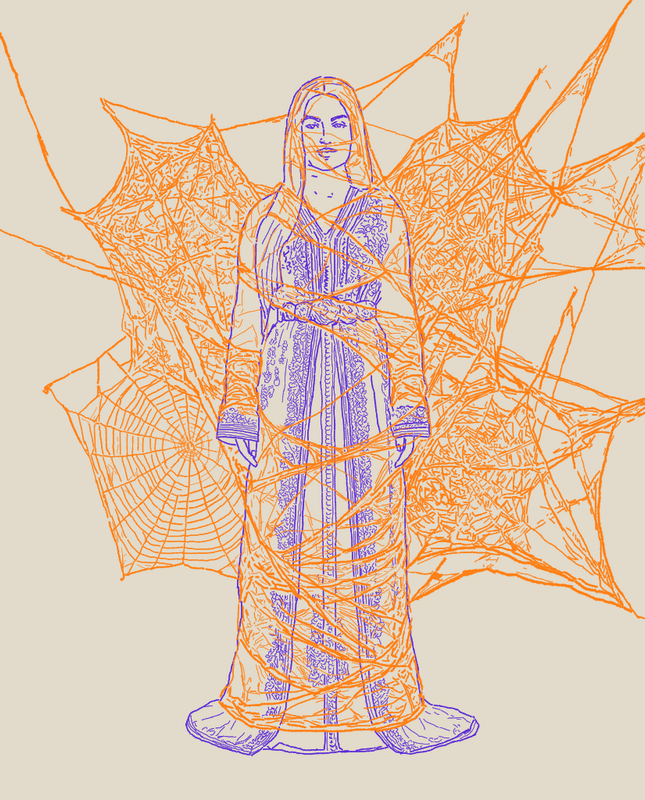
This deliberate caricaturizing of feminism is only one of many ways women are driven to reject it in hopes of avoiding further ostracization or the illusory thought that you and the ‘caricature’ have nothing in common. To a teenager it’s uncool, to a housewife it’s degrading, to a feminine woman it’s hostile to a veiled woman it’s Islamophobic and the list goes on.
So, whenever someone genuinely asks me about the movement, or how I define it, my answer is always the same: oppression. Oppression, because I feel silenced, deprived of choice, and obliged to bend to a list of rules and expectations I never agreed to, that don't match my reality, my person, or my dreams.
That being said, in order for me to talk about my oppression, first I need to identify the oppressor.
So, the question remains: who is my oppressor?
The Molds of Society
The first thing that identifies us in our societies is not our name, our needs, or our dreams; it is the not-so-custom-made cage where we will live. A perfect mold for the "perfect" human being, but only one half of society struggles to fit in. The half that is constantly forced to bend. Half of society has no choice but to conform to expectations; the other half enjoys the freedom of complexity.
We've all been fed the theories of "men being the rational half, yet unable to control their animal instincts"; of "men being unfit to maintain a family but fit to rule countries."These double standards grant men the right to fail without consequence, even when their failure harms others, while leaving accountability to only one half of society, thus, creating a deeply unfair power dynamic.
Society, as Rousseau describes it in Du Contrat Social, is an agreed-upon pact that draws individuals out of the state of nature; a condition in which they are completely free, dispersed, independent, and equal; yet at the mercy of a hierarchical wilderness. Through this contract, people gather in communities to protect and empower one another, redefining freedom, rights, and equality in the process.
True to the contradictions already present in Rousseau’s own writings, society has turned its back on women. It has taken them out of the brutality of the wilderness only to confine them within the domesticated boundaries of a zoo: sheltered, controlled, and stripped of the very freedom the social contract claimed to guarantee.
The distinction in treatment based on gender happens very early on. It precedes consciousness and even existence as it begins with the projection of ideas, hopes and expectations. An imposed essence made of clichés if you will. ‘I hope the baby is a girl so I can finally get help with chores.’ ‘I hope the baby is a boy so that there’s someone to carry the family name and legacy’. Now, you may be wondering what me and famed writer and Moroccan feminist figure Fatima Mernissi have in common (no you’re not).Well, not much really, besides a plight, a love for a blue pop of color on the eye, and complete alienation from a male childhood friend(s).
Indeed, one of the most interesting themes in her book , Rêves de femmes : une enfance au harem (Mernissi, 1996) describes how a little girl, during the early stages of self-discovery, stumbles for the first time on the pervasive patriarchal influences that shape her environment and life. This awareness comes through observing older women, but more importantly through the ever-growing gap between her and her male cousin. The story starts with an innocent friendship that focuses on their commonalities and ends with a sorrowful highlighting of all their differences. As they both slowly get a better understanding of social codes and hierarchies, their behavior evolves. You observe the boy as he’s slowly molded by his newly acquired awareness of his many privileges. A very common and familiar experience, I refer to as the earliest fracture.
Maybe part of the answer lies here, within the structure of society. But that mold, by itself, doesn't explain the scars of our lives.
Status Quo: Law, Politics & Traditions - A holy trinity
What are we, if not the continuation of our people's history? Where does our pride begin, if not with the soft whispers of stories sung at the height of the mountains, warming the desert nights? But what if those whispers grew into roars, and the melody turned into silence, a lonely night in the cold forest?
We are naturally drawn to preserve our traditions. Yet we often forget that traditions can be romanticized versions of our collective memory, that the lines have been twisted to glamorize the past, and that the price of those past glories was often paid by women.
Authority rhythms our day-to-day life from our earliest encounter with it, in the form of elders, then later on as policies and religious teachings. It is hard to come to terms with just how deep the patriarchy’s roots run in the fundamental institutions that shape the very fabric of society. The embedding of patriarchal ideas in tradition and religion etc. makes the act of challenging certain preconceived notions to be, disrespectful, unlawful sometimes even sacrilegious, thus fallaciously opposing women’s rights to societal cohesion itself.
The modern state built itself upon existing social structures, reinforcing them with law and order, rights and duties. But those laws were born from systems imposed on others, systems that never cared about equality.
And I mean not only gender inequality, but all inequalities inherited and entangled within this structure. Even in societies where a pretense of gender equality exists, it's often built upon the inequalities of race and class. In our local context, these inequalities only worsen. Misogyny grows wilder, layered into a complex, self-reinforcing mechanism.
Somehow, modern ideologies, political or not, no longer need to prove their capacity to solve real problems. Why would they, when in the grand circus of elections, one can build an entire platform around women's bodies, girls' consent, or their right to their own finances?
We are witnessing politics centering itself on oppression.
A system can only inherit oppression, out of convenience, if not as its very goal. A system will go as far as instrumentalizing what people hold on to most, if it serves its ideology.
The Hold of the Economic System
The war of power dynamics spread from small social structures into a wider playground: the global economic system. Over time, it evolved into a capitalist, liberal world that promises freedom and opportunity, yet thrives on consumerism.
The market keeps expanding, but our needs cannot evolve at the same pace. So, the very definition of "need" changes, no longer about survival, but about status and social existence.
We can all be victims of the economy, but only some must use it to justify their right to exist, and by the rule of supply and demand, must pay more for that existence. It starts with the pink tax and expands to the cruelty of the pharmaceutical industry's lack of investment in women's health.
Glass ceilings, not the pretty Pinterest kind, the wage gap, the non-recognition of domestic labor, undeclared employment, down to modern forms of slavery commonly found in farms, sweatshops and prisons etc. Capitalism is yet another tool for the subjugation of women. Financial struggle is one of the many layers that stand between us and emancipation. This system has made money a prerequisite for freedom, dignity, comfort and enjoyment all the while sabotaging, shaming and deterring women from seeking said stability. These conflicting pressures are but a piece of the greater paradox, that is, existing as a woman under the patriarchy. To many, fighting patriarchy is only secondary maybe even unnecessary to dismantling economic systems of oppression, which is a fundamentally flawed way of understanding capitalism and how it operates.
The intersection of the social system and the economic system has gone so far as to portray women as naturally weak, limiting them to domestic labor; a time- and energy-consuming, continuous task that forms the invisible foundation not only of the household but also of society and the economy; yet it is still dismissed as non-economic work.
The puzzle is almost complete. The image may have missing pieces, but what remains is enough to see the mechanism clearly.
The Foreign Liberation Movements
Harrowingly clumsy at best, disgustingly orientalist/racist at worst, the western approach to solidarity ironically claims to liberate WOC by taking on the role of the patriarch. Replacing one type of domination with another. It deems it more tasteful for women of the global south to be infantilized by white women or white activists in general, than it would by men of their communities. Surely policing must feel better when enacted by another woman, I wouldn’t dare challenge that logic as I am not white. What liberation looks like for women of the global south is for women of the global south to determine, as only they, understand how to navigate their communities and are equipped to advocate for themselves in a culturally sensitive manner.
You see, there is a quiet arrogance in believing that, where survival itself is a daily act of rebellion, women from the Global South must still look to the West for guidance.
It seems that imperialism continues to thrive, even within movements of liberation.
Sisters in the movement, our rights are not yours to pick and choose. Our lives, no matter how hard they may be, still allow our minds to think, our hearts to beat, and our lungs to crave the fresh air of freedom. True freedom begins with respecting the conditions, histories, and voices of others.
Me - The Internalized Misogyny
Was I ever on the other end of the spectrum? Perpetuating what I endured, on myself, on others?
It's painful to admit it. To live through it. To survive it. It's easier to comply. Fighting is draining. Screaming is exhausting. Maybe the mold will fit better if I reshape myself. Maybe the laws will seem fairer if I obey them. Maybe consumerism will soothe me if I work hard enough to afford it. But maybe, in a dark corner of my mind, lives a version of me who is worth the fight, the screams, the tears, the pure unfiltered rage. And maybe, in the real world beyond my thoughts, millions of others feel the same.
And the Question Remains: Who Is My Oppressor?
Simply put, these are all fragments of the same whole: the oh-so-famous Patriarchy. And even if you, readers, see patriarchy as a system designed to "protect" the weaker in a binary world, I would argue this: in a world defined by patriarchy, protection and aggression are two sides of the same coin. One cannot exist without the other. After all, one would not need protection if systematic danger did not exist. Perhaps naming the oppressor is my first act of defiance. Perhaps defiance is a continuous state, and freedom, an eternal chase worth having.
It’s far easier to approach misogyny as an external virus. Although years of dealing with it is likely to lead you to the same conclusion. Be it towards your perception of yourself or other women the work of deconstructing these pervasive ideas is a lifelong process. We owe each other the grace we’ve been denied; we owe each other more trust and understanding, more uplifting and respect. From the salary woman to the housewife and all other women whose labor is relegated to the status of invisibility, our demand is only one: equality.